
Begin with subject–verb–object
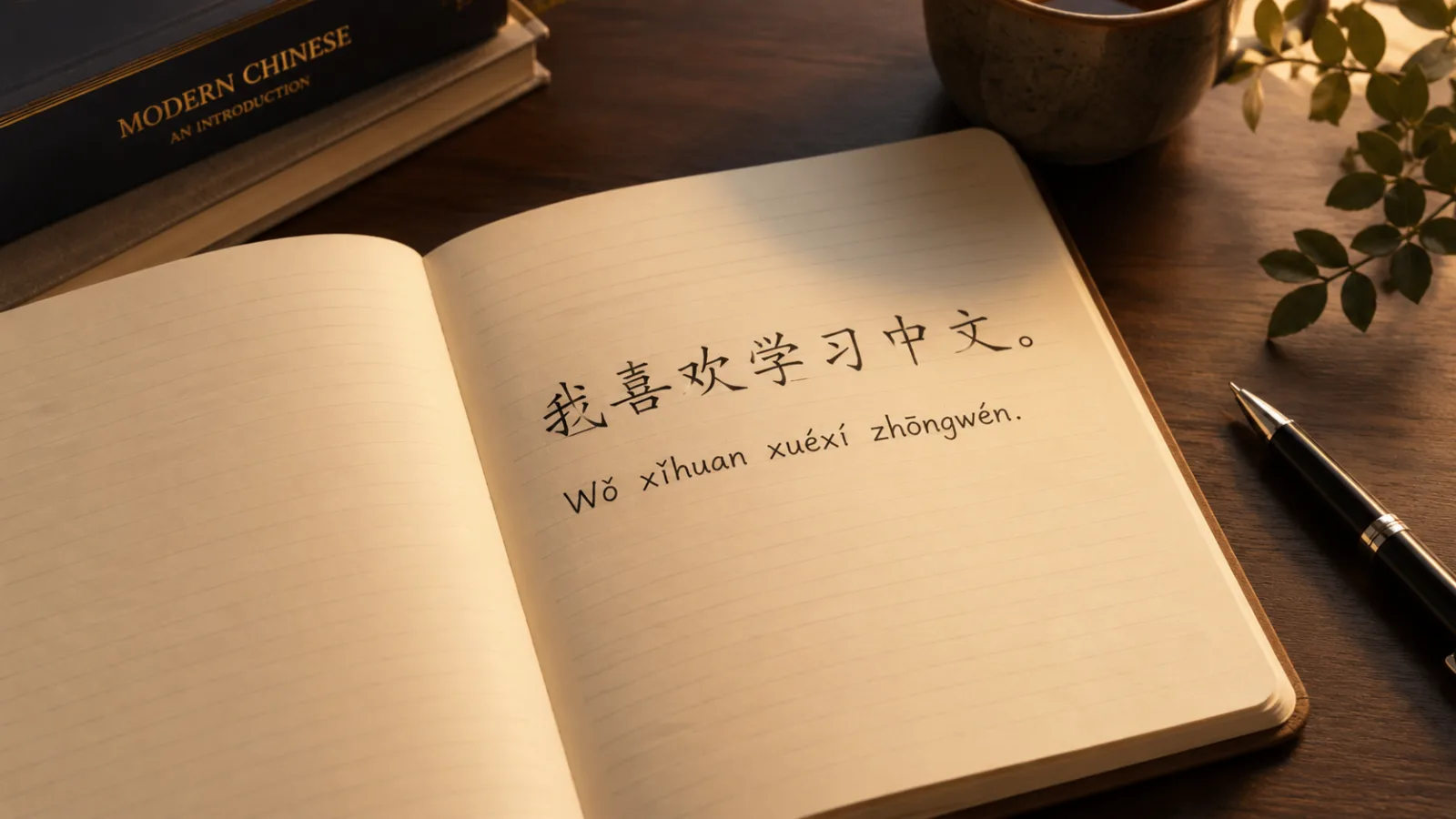
Many basic Mandarin sentences follow subject–verb–object order, similar to English. For example, 我学中文 (Wǒ xué Zhōngwén) means “I study Chinese.” The subject is 我, the verb is 学, and the object is 中文.
Chinese verbs do not change form for person or number. Context and time words usually show when an action happens, so learners can focus on word order and meaning.
Put time before the verb
Time expressions normally appear before the verb, often after the subject. 我今天学中文 means “I study Chinese today.” Moving 今天 before 学 tells the listener when the action takes place.
A useful beginner pattern is subject + time + place + verb + object. Build sentences one part at a time until this order becomes natural.
- 我今天在家学习。— I study at home today.
- 他明天去学校。— He goes to school tomorrow.
- 我们晚上看电影。— We watch a film in the evening.
Form questions without changing everything
Add 吗 (ma) to the end of a statement to form a yes-or-no question: 你学习中文吗? Question words such as 什么 (what), 谁 (who), and 哪里 (where) usually stay where the answer would appear.
This makes Chinese question order predictable. Practice changing familiar statements into questions instead of memorizing isolated rules.
Use negatives before the verb
不 (bù) commonly negates present, habitual, or future actions. 没 (méi) is commonly used for completed actions and with 有. Place the negative word directly before the verb or adjective it modifies.
Create pairs such as 我喝茶 / 我不喝茶 and 我有时间 / 我没有时间. Contrasting positive and negative forms makes the pattern easier to remember.
